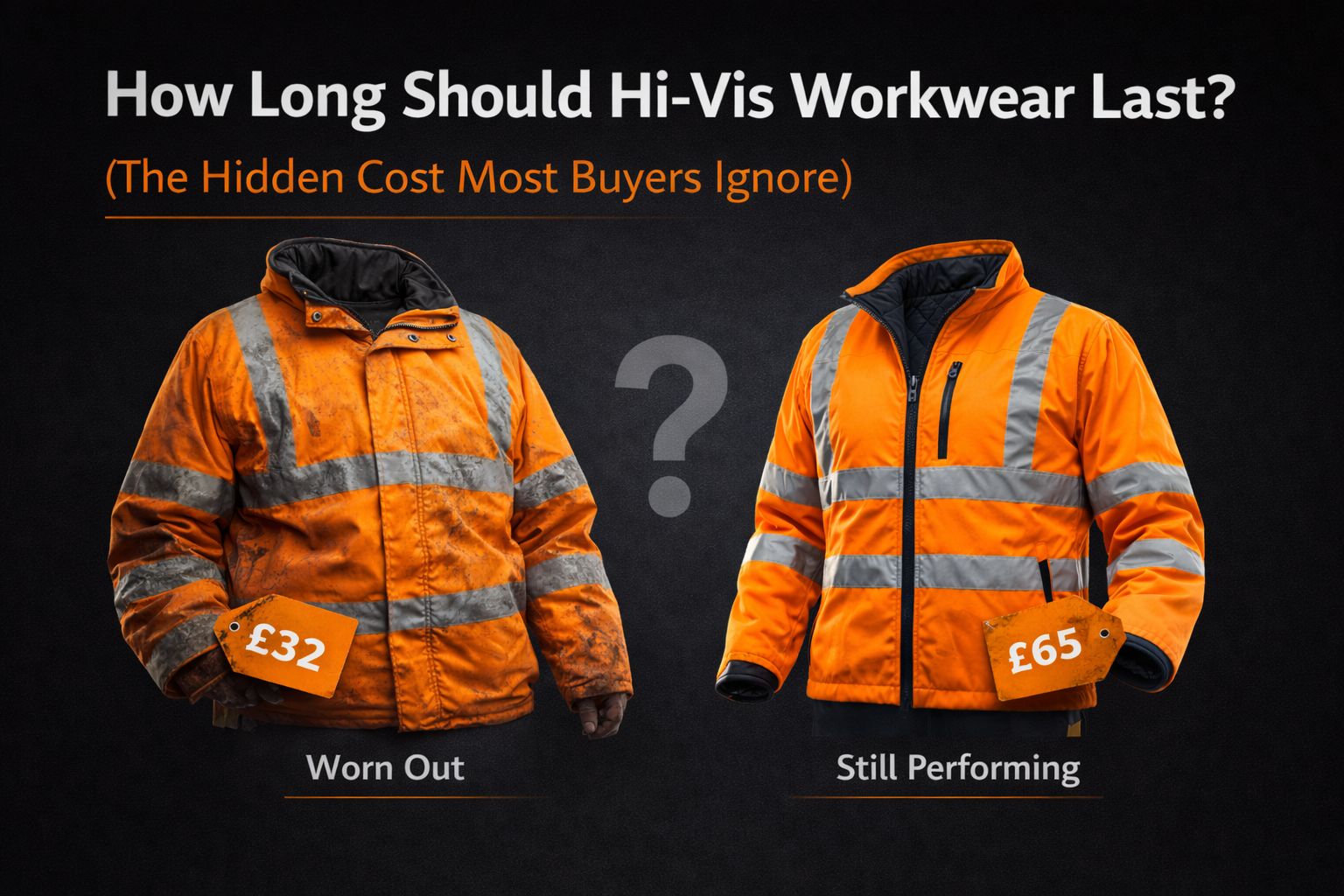
How Long Should Hi-Vis Workwear Last? (The Hidden Cost Most Buyers Ignore)
When companies purchase hi-vis workwear, the first comparison most buyers make is price.
But price alone rarely tells the full story.
Two jackets can both be EN ISO 20471 Class 3 compliant, both appear identical when new, and both technically meet safety requirements. Yet one may last 8 months, while another lasts 16 months or longer.
That difference can dramatically affect long-term workwear costs.
Understanding how long hi-vis clothing should realistically last on site helps procurement teams make better decisions and avoid the hidden cost of frequent replacement.
The Real Lifespan of Hi-Vis Workwear
The lifespan of hi-vis garments depends on several factors including:
• fabric weight and construction • reflective tape quality • wash durability • working environment • weather exposure • frequency of use
On typical UK construction and infrastructure sites, the lifespan of hi-vis jackets often falls into three general categories.
Jacket Type
Typical Lifespan
Low-cost traffic jackets
6–9 months
Mid-range durable jackets
12–16 months
Premium high-durability jackets
16–24 months
Cheap jackets may meet visibility standards when new but often deteriorate faster under real working conditions.
For teams working daily outdoors, particularly in construction, rail, or utilities, durability becomes just as important as compliance.
What “50 Wash Certification” Actually Means
One of the most misunderstood aspects of hi-vis workwear is wash durability certification.
Many garments are tested under EN ISO 20471, which includes performance checks after a declared number of washing cycles.
A garment rated for 50 washes means that under controlled testing conditions, the jacket should still meet visibility requirements after repeated washing.
However, real site conditions can be far harsher than laboratory testing.
Heavy abrasion, dirt contamination, weather exposure, and industrial washing can all accelerate wear. This is why some garments that technically pass certification still degrade quickly in practice.
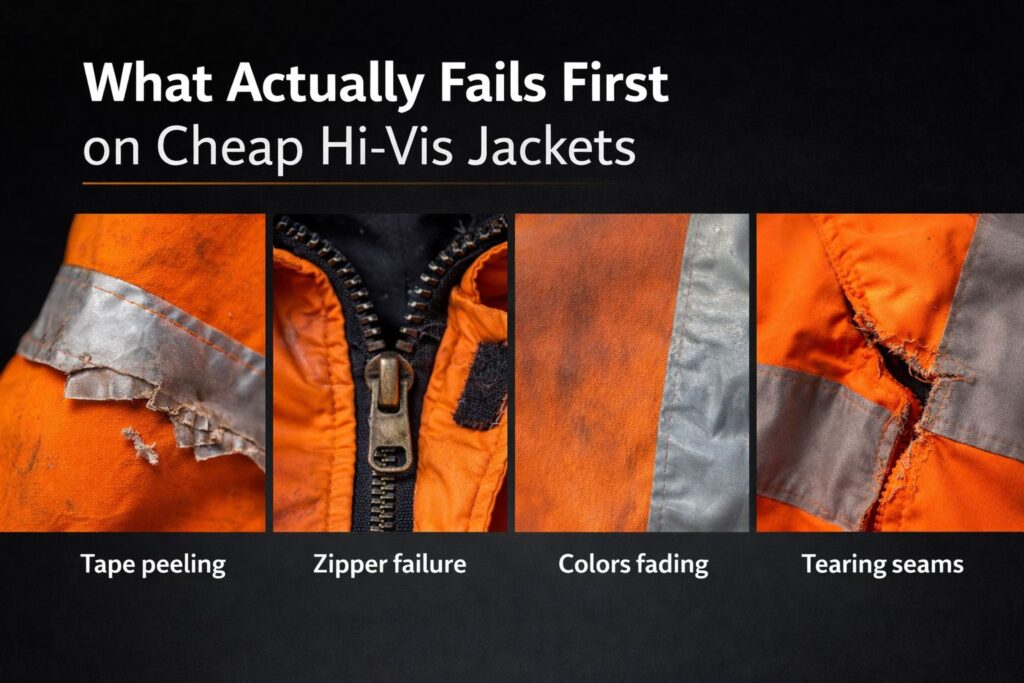
What Actually Fails First on Cheap Hi-Vis Jackets
When lower-quality garments begin to fail, it usually isn’t the certification label that reveals the issue first.
Instead, workers notice practical problems during daily use.
Common failure points include:
• reflective tape peeling or cracking • zip mechanisms breaking • colour fading reducing visibility • seams splitting under strain • fabric tearing around high-stress areas
Once these issues appear, the garment may still technically be wearable, but it quickly becomes less comfortable, less professional looking, and potentially less compliant.
For companies managing large teams, these failures often lead to early replacement orders.
The Hidden Cost of Frequent Replacement
The true cost of hi-vis clothing is not always the purchase price.
It’s the replacement cycle.
Consider a typical 20-person crew using two different jacket options.
Jacket Price
Lifespan
Estimated Cost Over 3 Years
£32 jacket
~8 months
~£2,400
£45 jacket
~16 months
~£2,100
£65 jacket
~24 months
~£1,950
The cheapest option initially appears to save money.
But frequent replacements increase total spend, while also creating additional administrative work and supply disruptions.
For procurement teams managing multiple crews, these small differences quickly scale.
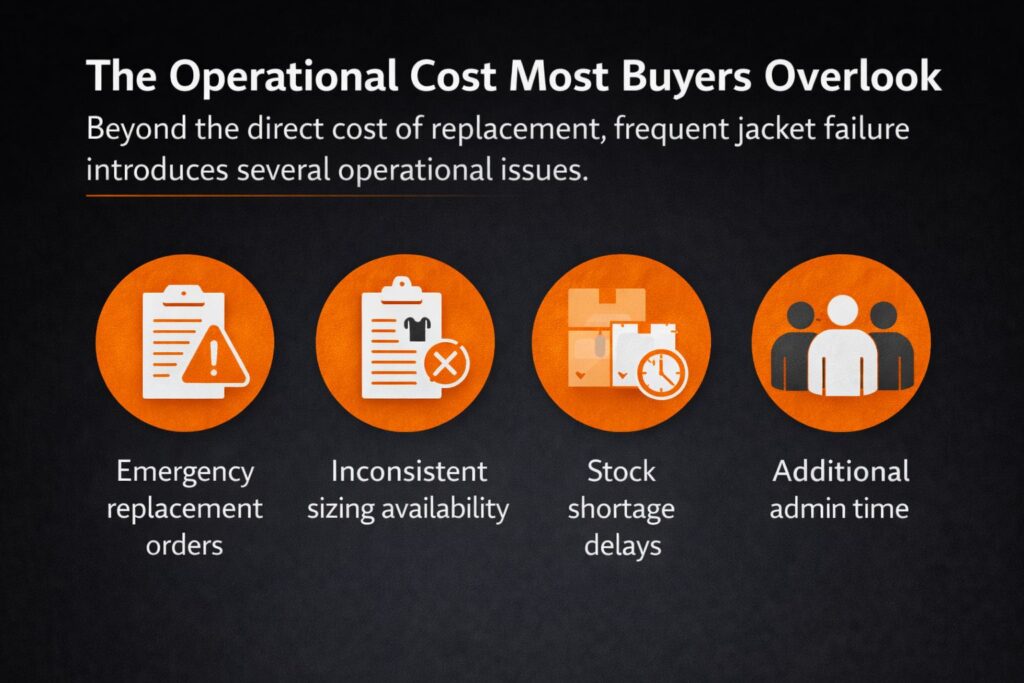
The Operational Cost Most Buyers Overlook
Beyond the direct cost of replacement, frequent jacket failure introduces several operational issues.
These include:
• emergency replacement orders • inconsistent sizing availability • delays due to stock shortages • additional admin time • inconsistent team appearance
Workwear that lasts longer reduces these disruptions and helps maintain a more consistent uniform standard across teams.
This is particularly important on larger infrastructure projects or rail environments where visibility and presentation standards are closely monitored.
How Buyers Should Specify Durable Hi-Vis Jackets
When specifying hi-vis jackets for construction, rail, or utilities work, buyers should look beyond the base price.
A better approach is to review several durability indicators.
Procurement teams should check:
• EN ISO 20471 certification • RIS-3279-TOM compliance (for rail work) • declared wash cycle performance • outer fabric strength (e.g. Oxford polyester) • reflective tape durability • construction quality of seams and zips
These details provide a clearer indication of how a garment will perform over time.
A Practical Buying Approach
Many experienced buyers now favour mid-range jackets designed for durability, rather than choosing the cheapest available option.
These products tend to offer:
• longer replacement cycles • improved comfort and fit • better long-term value
For teams working regularly in construction, infrastructure, or rail environments, jackets such asOAKLINE The Kimi fall into this category.
Designed with modern construction, durable materials, and long-term site use in mind, this type of jacket offers a balance between affordability and lifespan.
The result is often more predictable workwear costs and fewer replacement disruptions.
Final Thoughts
Hi-vis workwear is essential safety equipment, but it is also a long-term operational investment.
Choosing purely on upfront cost can often lead to higher spending over time due to frequent replacement cycles.
By focusing on durability, wash performance, and construction quality, procurement teams can reduce both costs and operational disruptions.
In many cases, the most effective purchasing strategy is not the cheapest jacket available — but the one that lasts the longest under real working conditions.