A Practical Rail Compliance Guide for UK Contractors & Procurement Teams
If you are buying high visibility clothing for rail work in the UK, you cannot afford to get this wrong.
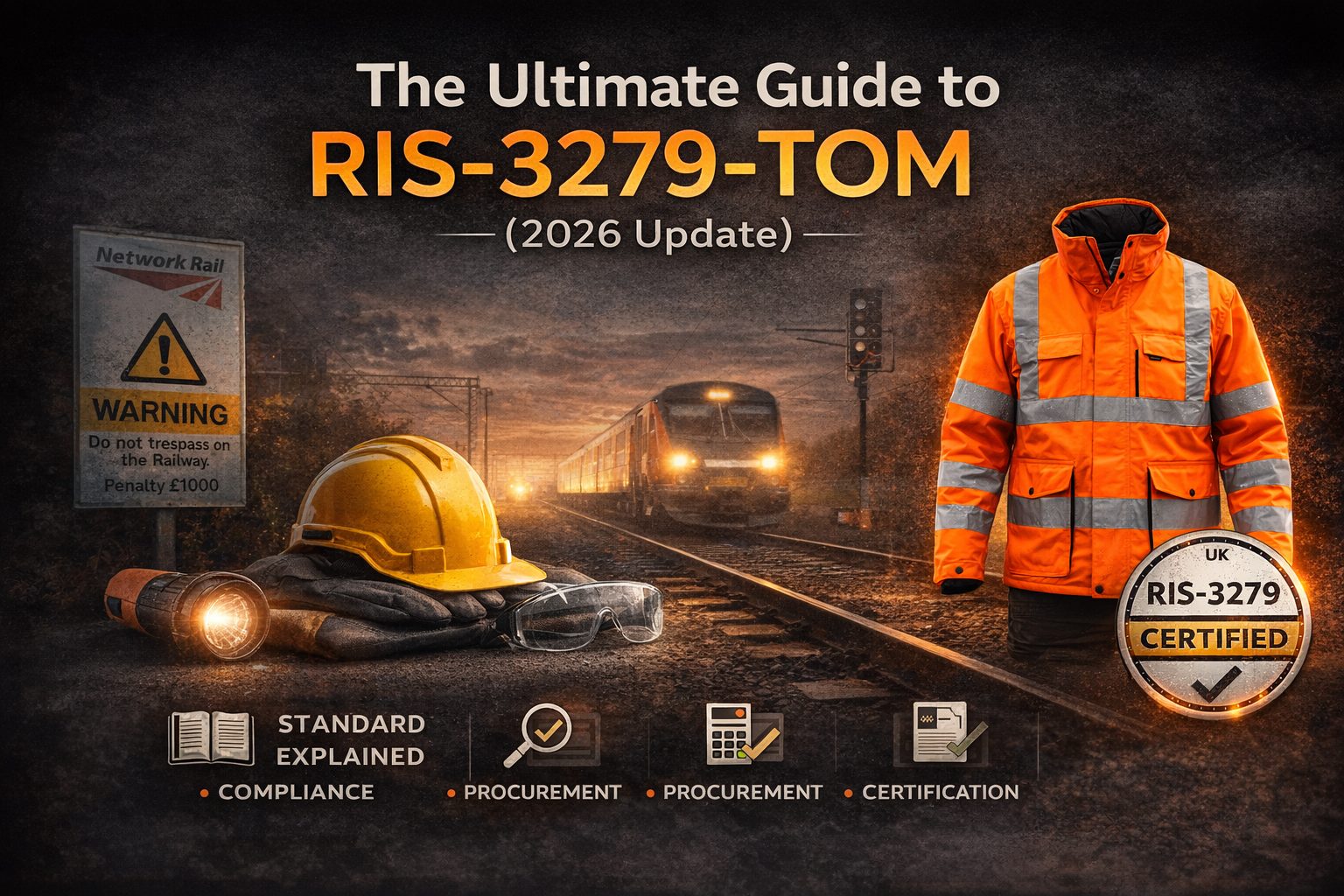
RIS-3279-TOM is not just another code on a swing tag. It is a mandatory requirement for working on or near Network Rail-controlled infrastructure.
And yet, every year, contractors still:
• Order yellow instead of orange • Assume Class 3 automatically means rail compliant • Ignore wash durability • Overpay for branding instead of performance
This guide explains RIS-3279-TOM properly - without the marketing noise.
What Is RIS-3279-TOM?
RIS-3279-TOM is the Railway Industry Standard that governs high-visibility clothing for use on UK rail infrastructure.
It builds on EN ISO 20471 but adds additional railway-specific requirements.
In simple terms:
Standard
What It Covers
Where It Applies
EN ISO 20471
General high-visibility compliance
Construction, highways, utilities
RIS-3279-TOM
Rail-specific high-visibility requirements
Network Rail infrastructure
A garment must first comply with EN ISO 20471 before it can meet RIS-3279-TOM.
But EN ISO 20471 alone is not enough for rail.
The Full Orange Policy (Why Yellow Is Not Acceptable)
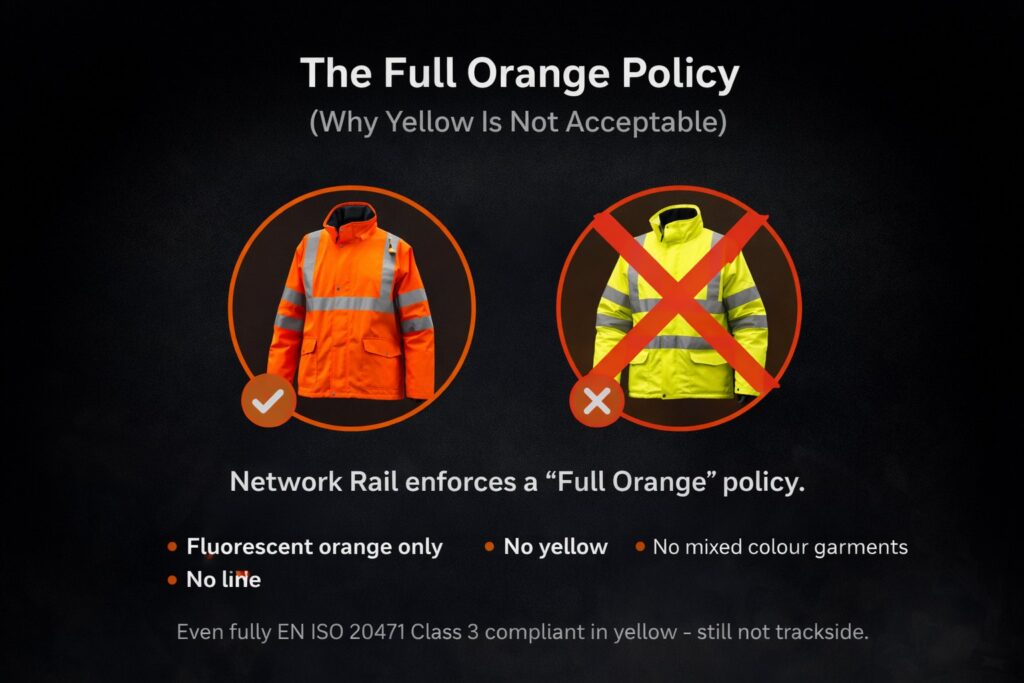
Network Rail enforces a “Full Orange” policy.
This means:
• Fluorescent orange only • No yellow • No lime • No mixed colour garments
Why?
Because yellow and green tones can interfere with signal recognition and visual clarity in rail environments.
You can be fully EN ISO 20471 Class 3 compliant in yellow - and still not be allowed trackside.
For procurement teams, this is one of the most common mistakes.
When linking, keep it neutral. Present it as an example, not a hard sell.
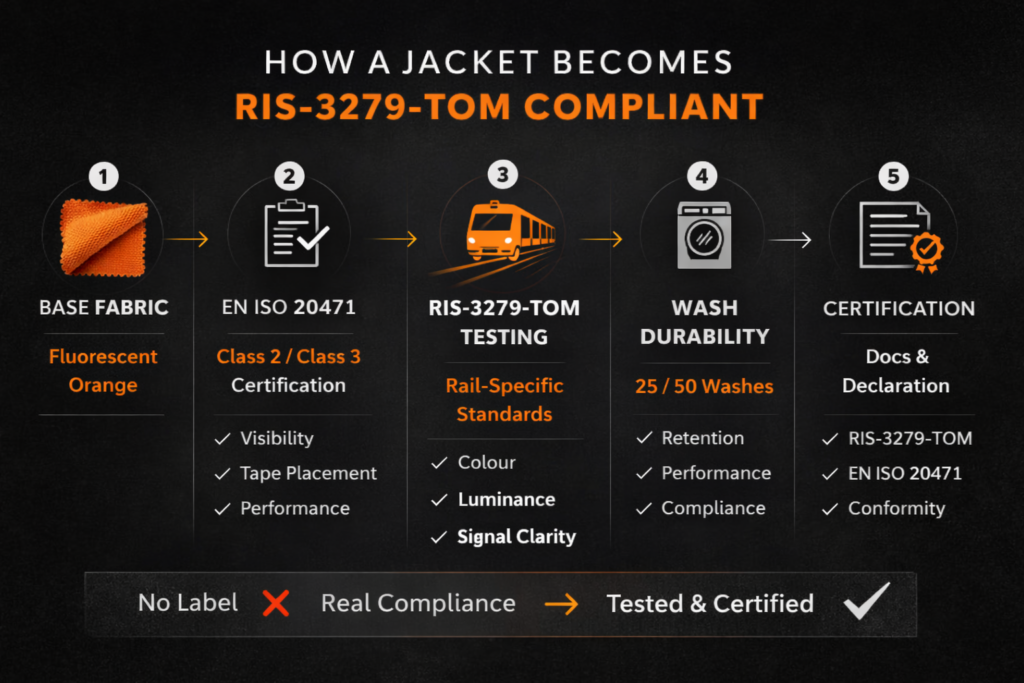
How Manufacturers Make a Jacket RIS-3279-TOM Compliant
RIS-3279-TOM compliance does not happen by printing “rail approved” on a label.
There is a structured technical process behind it.
Understanding that process helps procurement teams separate genuine compliance from marketing claims.
1️⃣ Base Fabric Selection (Fluorescent Orange Only)
The process begins with fabric.
The outer shell must:
• Be fluorescent orange • Meet specific chromaticity values • Achieve minimum luminance performance • Pass colour fastness testing
The orange dye formula is not arbitrary. It must fall within defined railway visibility parameters.
If the base fabric fails colour testing, the garment cannot progress further.
2️⃣ EN ISO 20471 Certification First
Before RIS-3279-TOM testing begins, the garment must first pass:
• EN ISO 20471 Class 2 or Class 3 • Retroreflective tape placement ratios • Minimum background material surface area • Photometric performance thresholds
If visibility drops below required thresholds, certification fails.
This is one of the most overlooked aspects of rail compliance.
5️⃣ Documentation & Declaration of Conformity
Once testing is complete, manufacturers issue:
• EN ISO 20471 certificate • RIS-3279-TOM certification • UK/EU Declaration of Conformity • Technical file documentation
Rail buyers should always request this documentation.
If a supplier cannot provide it, that is a red flag.
Why This Process Matters for Buyers
When you understand the certification pathway, you can ask better questions.
For example:
• Was the garment tested to 25 or 50 washes? • Is the tape heat-applied or stitched? • Has the orange fabric been tested post-wash for luminance retention? • Can I see the Declaration of Conformity?
This is where real supplier expertise becomes visible.
How Modern Rail Jackets Are Engineered for Compliance & Longevity
Modern rail garments designed with lifecycle value in mind typically include:
• 300D PU-coated Oxford outer for durability • Heat-applied segmented reflective tape to reduce cracking • Reinforced seams in high-abrasion zones • 50 wash certification to extend compliant lifespan
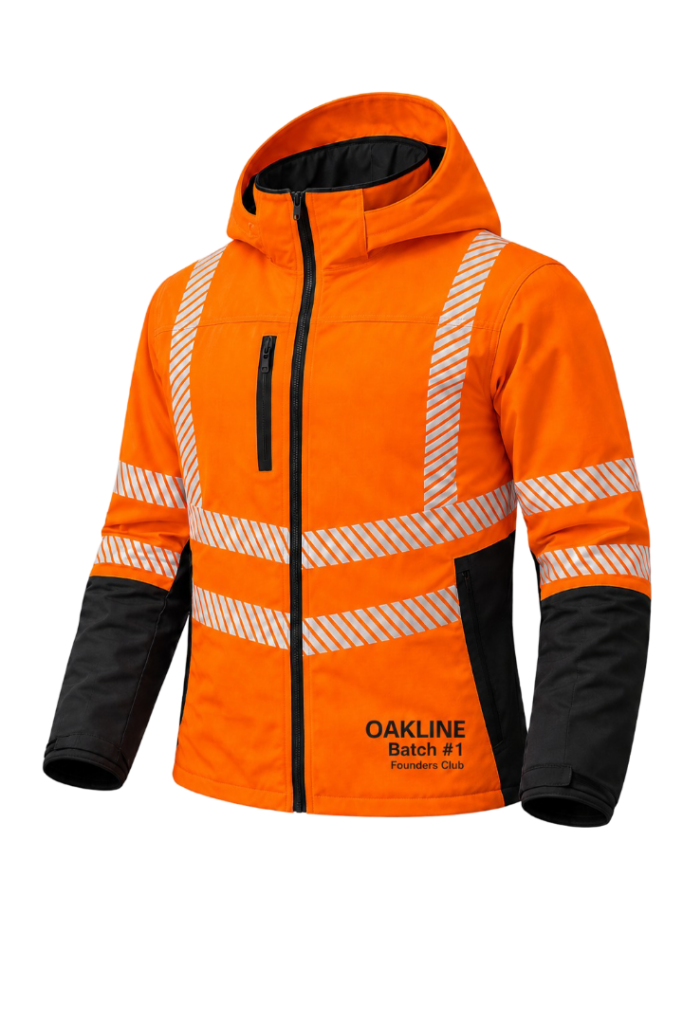
For example, rail-spec jackets such as the OAKLINE PRO The Kimi are engineered around this exact compliance pathway — combining RIS-3279-TOM certification with extended wash durability and segmented tape for improved longevity.
(Internal link here to OAKLINE product page.)
Notice what we did:
We didn’t say “buy this.” We said “this is how it’s engineered.”
That builds authority without weakening neutrality.
Common Rail Procurement Mistakes
• Buying yellow for trackside • Assuming all Class 3 jackets are equal • Ignoring wash durability • Paying for branding without technical delta • Not verifying certification documentation
RIS-3279-TOM is binary.
You either meet it. Or you do not.
FAQ Section
What does RIS-3279-TOM stand for?
RIS-3279-TOM is the Railway Industry Standard governing high-visibility clothing for UK rail infrastructure.
Is EN ISO 20471 enough for rail work?
No. The garment must specifically state RIS-3279-TOM compliance and be fluorescent orange.
How many washes should a rail jacket be certified for?
Ideally 50 washes for long-term value in high-use environments.
Can yellow hi-vis be worn on Network Rail sites?
No. The Full Orange policy requires fluorescent orange garments only.
Certification References Buyers Should Request
• EN ISO 20471 certificate • RIS-3279-TOM certificate • UK/EU Declaration of Conformity • Wash durability statement • Fabric composition specification
This documentation should be available on request.